Free IELTS Essay Checker: Instant Red Pen Feedback on Your Writing Task 2 Essay
Every IELTS teacher's red pen circles the same things. In this day and age in the first line. Moreover three times in one essay. Kids instead of children, goverment without its n, and one sentence that runs for five lines.
None of these is hard to fix. The hard part is seeing them in your own writing, especially when nobody is marking your practice essays.
So here is a red pen you can use yourself. The Red Pen marks your IELTS essay the way a teacher would, with circles, underlines and notes in the margin, then checks it against what the official band descriptors reward. It is free, there is nothing to sign up for and your essay never leaves your browser.
Quick answers
Is there a free IELTS essay checker? Yes. The Red Pen on this page is free, needs no sign up and runs in your browser, so your essay is not uploaded anywhere. Paste a Task 1 or Task 2 answer and it marks copied words, overused linking words, informal language, repetition, spelling and sentence range, then shows which part of the official band descriptors each problem affects.
How many words should IELTS Writing Task 2 be? At least 250 words, and Task 1 needs at least 150. The Writing test lasts 60 minutes, and IELTS suggests about 40 minutes for Task 2 and 20 minutes for Task 1. IELTS also warns that a very short answer may not give enough evidence of the language needed for the higher bands.
Do contractions lose marks in IELTS Writing? No rule bans them, but IELTS essays are formal writing, and Band 7 for Lexical Resource describes “an awareness of style and collocation”. Contractions such as don't and it's, and chatty words such as kids and a lot of, make an essay sound informal. Write do not, it is, children and many instead.
Can an IELTS essay checker give an accurate band score? Not reliably. Your real score comes from trained examiners who judge four criteria together, including whether your ideas answer the question and are well developed. Software can count words and spot patterns, but it cannot judge those things reliably. That is why the Red Pen shows you specific problems to fix instead of guessing a band.
How is IELTS Writing marked? Each task is marked on four criteria: Task Achievement (Task 1) or Task Response (Task 2), Coherence and Cohesion, Lexical Resource, and Grammatical Range and Accuracy. Task 2 contributes twice as much as Task 1 to your Writing score.
The Red Pen: free IELTS essay checker
A sample essay is already marked below, so you can see how it works. Replace it with your own answer, add the question if you have it and press Mark my essay. Use the tabs to switch between a Task 2 essay and an Academic Task 1 report.
Your essay stays private. The Red Pen runs entirely in your browser. Nothing you type is uploaded or saved, and it works on your phone.
How IELTS Writing is marked
The Writing test lasts 60 minutes and has two tasks. In Academic Task 1 you describe a graph, chart, table or diagram in at least 150 words. In Task 2 you write an essay of at least 250 words in response to a point of view, argument or problem. Task 2 contributes twice as much as Task 1 to your Writing score, so it deserves most of your practice time. General Training candidates also write an essay for Task 2, so the checker works for them too.
Examiners mark each task against four criteria:
Task Achievement or Task Response. Do you answer every part of the question, with a clear position and relevant, well developed ideas?
Coherence and Cohesion. Is your writing logically organised in clear paragraphs, with linking that helps the reader rather than getting in the way?
Lexical Resource. Is your vocabulary wide, accurate and suitable for formal writing?
Grammatical Range and Accuracy. Do you use a variety of sentence structures, and how many errors do you make?
“If your answer is too short, there may not be enough evidence of the language features needed in order to award higher bands.” IELTS
What the red pen checks, and why
The Red Pen runs 12 checks, grouped under the four criteria. Each one targets a habit that the band descriptors mention, and the checker shows the descriptor wording next to every problem it finds.
Task Response
Length. Under 250 words for Task 2, or 150 for Task 1, is marked in red.
Clear position. If the question asks for your opinion, the red pen looks for it in your introduction and your conclusion. Band 7 says: “A clear and developed position is presented.”
Conclusion. Your final paragraph should clearly conclude, not add new ideas. At Band 6, “the conclusions drawn may be unclear, unjustified or repetitive”.
Copied from the question. Add the question and the red pen crosses out every run of seven or more words copied from it. The descriptors are blunt: “Any copied rubric must be discounted.”
In Task 1 mode, the red pen looks for an overview instead of an opinion and flags personal opinions, which do not belong in a report. Band 7 for Task Achievement says: “It presents a clear overview, the data are appropriately categorised, and main trends or differences are identified.”
Coherence and Cohesion
Paragraphing. Four or five paragraphs for Task 2, and three or four for Task 1. At Band 5, “Paragraphing may be inadequate or missing.”
Range of linking words. How many different linking words and phrases you use, such as however, therefore and for example. Band 7 describes “a range of cohesive devices including reference and substitution” used flexibly.
Mechanical linking. The check most students fail. Using Moreover three times, or starting almost every sentence with a linking word, is what Band 6 describes as cohesion that is “faulty or mechanical due to misuse, overuse or omission”.
Lexical Resource
Academic style. Contractions such as don't and it's, chatty words such as kids, stuff and a lot of, sentences that begin with And, But or So, and exclamation marks.
Repetition. Words you use too often, including the key words from the question, with synonyms to try. At Band 5, “a lack of flexibility is apparent in frequent simplifications and/or repetitions”.
Spelling and word forms. About 150 of the most common learner errors, from goverment and beleive to uncountable nouns used in the plural, such as informations and advices. Band 7 allows “only a few errors in spelling and/or word formation”.
Stock phrases. Memorised openers such as In this day and age and Every coin has two sides. Examiners see them constantly, and the band descriptors list memorised language among the features of the lowest bands.
Grammatical Range and Accuracy
Sentence range. The share of your sentences that use complex structures, such as clauses with which, although or because, or the passive. It also flags any sentence over 40 words. At Band 6, “A mix of simple and complex sentence forms is used but flexibility is limited.”
The red pen cannot tell you whether your ideas are good. It can show you, in seconds, the habits that hide them.
Before and after: one introduction, rewritten
This is the introduction of the sample essay in the checker. The red pen finds a stock phrase, 26 words copied from the question, a spelling mistake and the first of nine uses of the word language.
Before: In this day and age, learning a foreign language is very important. Some people think that children should start learning a foreign language at primary school rather than at secondary school. I beleive the advantages of this outweigh the disadvantages.
After: Many education systems now introduce a second language in the first years of schooling instead of waiting until children are eleven or twelve. Although this early start has some drawbacks, I believe its benefits are considerably greater.
The stock opener has gone. The question is paraphrased instead of copied: a foreign language becomes a second language, and primary school becomes the first years of schooling. The position is still clear, and the Although clause adds a complex sentence. Try both versions in the checker and compare the marks.
Why the red pen does not give you a band score
Many online checkers promise an instant band score. Treat those numbers with care. Your real score comes from trained examiners who judge all four criteria together, and the questions that matter most, such as whether your ideas are relevant, well supported and fully developed, are the hardest for software to answer.
A wrong number can hurt you either way. A score that is too high sends you into the test before you are ready, and one that is too low can knock your confidence for no reason.
So the Red Pen gives you something you can act on today: specific problems, where they are and which part of the descriptors they affect. To see how criterion scores turn into a Writing band, and how Writing combines with the other skills, read how IELTS band scores are calculated.
A 10 minute editing routine for every practice essay
Use this routine after every timed essay, with or without the checker. In the real test, a quick version of steps 1, 3 and 4 fits into the last three minutes.
1. Check the question (1 minute). Have you answered every part? If it asks for your opinion, is your opinion in the introduction and the conclusion?
2. Count paragraphs and words (1 minute). Aim for four or five paragraphs and at least 250 words. In the test, count the words in three lines, divide by three and multiply by the number of lines you wrote.
3. Circle every linking word (2 minutes). If the same one appears twice, change one. If most sentences start with one, rewrite a few to start with the subject.
4. Hunt for informal language (2 minutes). Expand contractions, change kids to children and a lot of to many or much, and rewrite sentences that begin with And, But or So.
5. Underline repeated words (2 minutes). Replace some with synonyms or pronouns, especially the key words from the question.
6. Look for your own typical errors (2 minutes). Most students repeat the same few mistakes, such as articles, plurals or verb tenses. Keep a list of yours and check for them last.
Get your essays marked by a teacher
The red pen catches patterns. A teacher can tell you whether your argument works, which ideas need developing and exactly what is holding your score back.
Ali Gharji has more than 13 years of experience teaching English in UK colleges and universities. He holds an MA in International Education and Development from the University of Sussex, a BA in English Language and Literature and the Cambridge CELTA, and has completed the British Council IELTS Trainer Masterclass.
One to one IELTS lessons last one hour, take place online on Zoom or Google Meet and include written feedback on your writing and a study plan built around your test date.
Share the Red Pen with a friend who is preparing for IELTS. It is free and works on any phone.
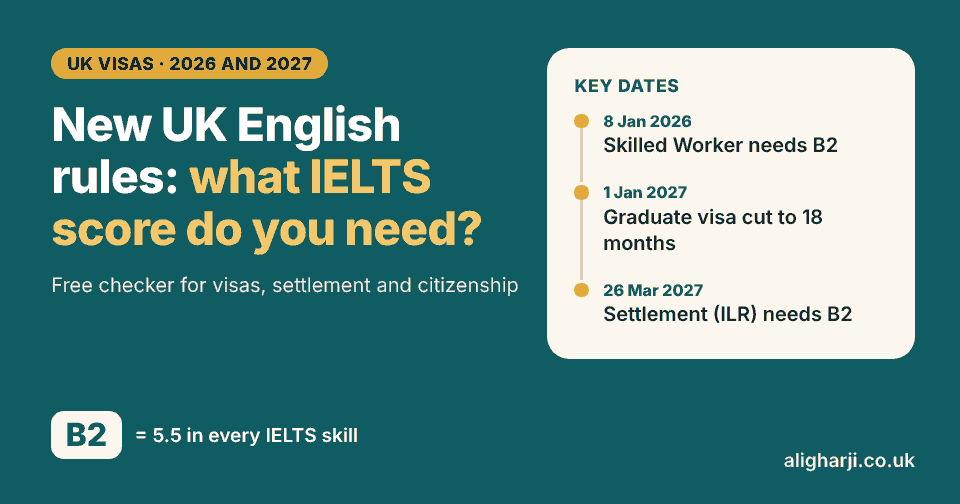
Related reading: IELTS band score calculator, 5 IELTS Writing Task 2 mistakes that cost you marks, IELTS Writing preparation tips, Academic writing and everyday writing, IELTS vs TOEFL in 2026 and New UK English rules: which IELTS score you need.
Important
The Red Pen is an independent practice tool, not an official IELTS product, and it does not predict your band score. Quotations are from the public IELTS Writing band descriptors (updated May 2023) and the official IELTS website. IELTS is jointly owned by the British Council, IDP IELTS and Cambridge University Press & Assessment. Updated October 2026.
Sources
IELTS. Writing band descriptors for Task 1 and Task 2, updated May 2023, hosted by the British Council.
IELTS (2023). IELTS Writing band descriptors and key assessment criteria.
Comments