IELTS Band Score Calculator: How Band Scores Are Calculated (With Examples)
Updated: 11 hours ago
One of the most common questions my students ask is how their overall IELTS score is worked out. The system is simpler than it looks, but a few details, especially the rounding rule, can make the difference between the score you need and the one just below it.
IELTS band score calculator
Choose your four skill bands to see your overall score and exactly how it was rounded, or switch to the second tab to convert Listening and Reading marks out of 40 into a band. The calculator also shows what you would need for the next band up. Everything it does is explained step by step below.
Quick answers
How do I calculate my overall IELTS band score? Add your four skill bands, divide by four and round to the nearest half band. Averages ending in .25 round up to the next half band and averages ending in .75 round up to the next whole band, so 6.5 + 6.0 + 5.5 + 7.0 = 25.0, and 25.0 ÷ 4 = 6.25, which becomes 6.5.
What does 6.25 mean in IELTS? An average of 6.25 across the four skills rounds up to an overall band of 6.5.
What does 6.75 mean in IELTS? An average of 6.75 rounds up to an overall band of 7.0.
What about 6.125? An average of 6.125 rounds down to 6.0.
How many correct answers do I need for Band 7? Typically 30 out of 40 in Listening, 30 in Academic Reading and 34 in General Training Reading. Full tables are below.
The IELTS band scale
IELTS is scored on a scale from 0 to 9, in half-band steps. You receive a separate band for each of the four skills (Listening, Reading, Writing and Speaking) plus an overall band score.
How the overall band is calculated
Your overall band is the average of your four skill bands, rounded to the nearest half band. The rounding rule is where most confusion comes from:
An average ending in .25 rounds up to the next half band (6.25 becomes 6.5).
An average ending in .75 rounds up to the next whole band (6.75 becomes 7.0).
Anything else rounds to the nearest half or whole band (6.125 becomes 6.0, and 6.875 becomes 7.0).
Example 1: Listening 6.5, Reading 6.0, Writing 5.5, Speaking 7.0. The total is 25.0, and 25.0 divided by 4 is 6.25, so your overall band is 6.5.
Example 2: Listening 7.5, Reading 7.0, Writing 6.0, Speaking 6.5. The total is 27.0, and 27.0 divided by 4 is 6.75, so your overall band is 7.0.
This is why improving your weakest skill by just half a band can lift your overall score.
Listening and Reading: from correct answers to bands
Listening and Reading each have 40 questions, with one mark per correct answer. Your total out of 40 is converted into a band using the tables below. Listening uses the same table for Academic and General Training, but Reading does not: General Training Reading needs more correct answers for the same band, because its texts are less demanding.
Listening (Academic and General Training)
39 to 40 correct: Band 9.0
37 to 38 correct: Band 8.5
35 to 36 correct: Band 8.0
32 to 34 correct: Band 7.5
30 to 31 correct: Band 7.0
26 to 29 correct: Band 6.5
23 to 25 correct: Band 6.0
18 to 22 correct: Band 5.5
16 to 17 correct: Band 5.0
Academic Reading
39 to 40 correct: Band 9.0
37 to 38 correct: Band 8.5
35 to 36 correct: Band 8.0
33 to 34 correct: Band 7.5
30 to 32 correct: Band 7.0
27 to 29 correct: Band 6.5
23 to 26 correct: Band 6.0
19 to 22 correct: Band 5.5
15 to 18 correct: Band 5.0
General Training Reading
40 correct: Band 9.0
39 correct: Band 8.5
37 to 38 correct: Band 8.0
36 correct: Band 7.5
34 to 35 correct: Band 7.0
32 to 33 correct: Band 6.5
30 to 31 correct: Band 6.0
27 to 29 correct: Band 5.5
23 to 26 correct: Band 5.0
Example: 24 correct answers out of 40 is Band 6.0 in Academic Reading, but only Band 5.0 in General Training Reading. Make sure you use the table for the test you are taking.
These are the typical conversion points published by IELTS. The exact number of correct answers needed can shift slightly between test versions, so treat a score right on a boundary as approximate.
Writing: four criteria, two tasks
Examiners mark your writing against four equally weighted criteria: Task Achievement (Task Response in Task 2), Coherence and Cohesion, Lexical Resource, and Grammatical Range and Accuracy. Task 2 counts for twice as much as Task 1, so give it the time it deserves. For the most common reasons essays lose marks, read my guide to 5 IELTS Writing Task 2 mistakes.
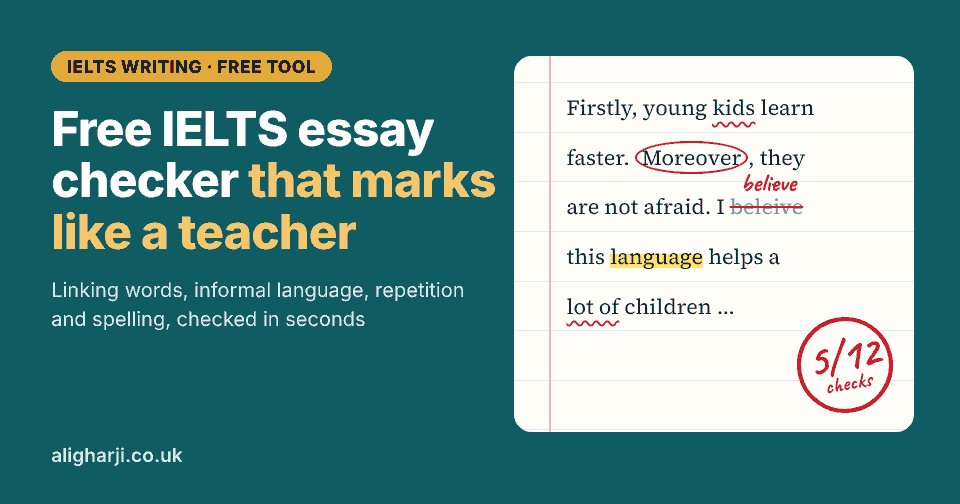
Want to check your writing before test day? Try The Red Pen, a free IELTS essay checker. Paste a Task 1 or Task 2 answer and it marks the problems examiners notice, from words copied from the question to overused linking words.
Speaking: four criteria
Speaking is also marked on four equally weighted criteria: Fluency and Coherence, Lexical Resource, Grammatical Range and Accuracy, and Pronunciation. Hesitating constantly to avoid every possible mistake can lower your Fluency and Coherence score, so aim for natural, extended answers.
What score do you need?
Requirements depend on your university, course or visa. Many UK universities ask for an overall band between 6.0 and 7.0, often with a minimum score in each skill, so check both numbers. A strong overall band won't help if one skill falls below the minimum.
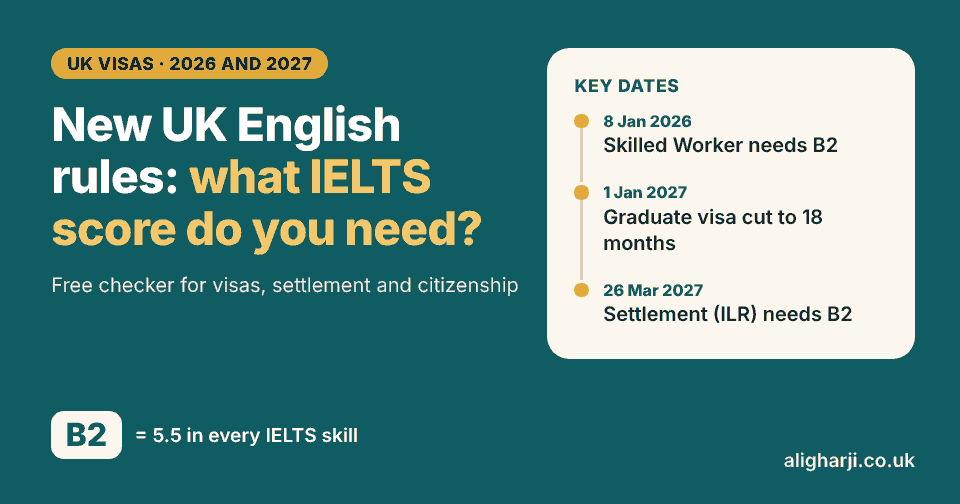
Still deciding which test to take? Read my comparison of IELTS vs TOEFL in 2026, including which test UK visa routes accept.
Need help reaching your target band?
If you're half a band or a whole band away from your target, focused practice on your weakest skill usually makes the biggest difference. My IELTS Preparation course includes full practice tests, detailed written feedback and a study plan built around your target score, delivered one-to-one online. Book your first session here.
Related reading: IELTS Speaking tips for Parts 1, 2 and 3.
Comments