Wrote It Yourself but Flagged for AI? Why It Happens to International Students (and What to Do)
A student at an English university once explained to a misconduct panel that they had used Google to find synonyms, because English was not their first language. The panel recorded this as an admission of using AI to paraphrase. When the student took the case to the Office of the Independent Adjudicator (OIA), the ombudsman for universities in England and Wales, it partly upheld the complaint. One of its findings: the university had never asked whether its AI detector might be less reliable for non-native English speakers.
If English is your second language and you are starting a new term, this is worth ten minutes of your time. Below I explain why AI detectors misjudge international students, which words make writing sound machine-made, a free checker you can use on your own essays, and six steps to take if you are ever accused.
Quick answers
Can AI detectors be wrong? Yes. Turnitin itself says its detector can misidentify human writing, and that false positives are more likely when it finds less than 20% AI writing in a document. A detector score is a probability, not proof.
Why are international students flagged more often? Detectors look for predictable, low-variety writing. Writing in a second language often uses a smaller range of words and simpler sentence patterns, which the software can mistake for AI.
Is an AI score enough to prove misconduct? It should not be. Turnitin's own chief product officer has said scores should not be the only basis for misconduct cases, and the OIA has upheld complaints where students were not shown the evidence or given a fair chance to respond.
Can I use Grammarly or a translation tool? It depends on your university and module. Check the policy, and if a tool is allowed, say that you used it.
What should I do if I am accused? Stay calm, ask to see the evidence, gather your drafts and notes, and get free advice from your Students' Union. The six steps are below.
Why detectors misjudge second-language writing
Most AI detectors measure how predictable a piece of writing is. Language models produce text by choosing likely next words, so writing that uses common words in common patterns looks more AI-like to the software. The trouble is that careful second-language writing often looks exactly like that: shorter sentences, a smaller vocabulary and fewer idioms.
In a 2023 study, Stanford researchers tested seven widely used detectors on 91 TOEFL essays written by non-native English speakers. On average the detectors labelled 61% of these human-written essays as AI-generated, and 97% of the essays were flagged by at least one detector. On essays by US eighth-graders, the same tools were almost perfect. The researchers' advice was clear: avoid relying on detectors in education, especially where many students are non-native speakers.
Turnitin, the tool most UK universities use, says its false positive rate is under 1% for documents where it detects more than 20% AI writing. It also admits the rate is higher below that threshold, and puts its sentence-level false positive rate at around 4%. Some universities have decided the risk is too high. UCLA and UC San Diego stopped using Turnitin's AI detection in 2024, the University of Waterloo in September 2025 and Curtin University in January 2026. At Washington State University, which switched it off in February 2026, a third of the AI cases its integrity board reviewed between 2023 and 2025 were dismissed because the detector score was the only evidence.
The numbers behind the worry
75% of UK students who use AI tools say they are stressed about being wrongly flagged, according to a 2026 YouGov poll of 2,373 students for Studiosity. International students were twice as likely as others to report a lot of stress when using AI.
24% of all UK higher education students, and 51% of postgraduates, are international students.
Almost 7,000 proven cases of AI cheating were recorded at UK universities in the 2023/24 academic year, according to a Guardian investigation. Misuse is real, which is exactly why the checks need to be fair.
The words that make writing sound like AI
When ChatGPT arrived, certain words suddenly became far more common in academic writing. A team led by researchers at the University of Tübingen analysed more than 15 million biomedical abstracts and found that in 2024 delves appeared 28 times more often than expected, underscores almost 14 times and showcasing almost 11 times. Everyday academic words such as crucial, comprehensive, additionally, notably and insights rose sharply too.
Here is the uncomfortable part for international students: many of these are exactly the formal words we are taught to use to sound academic. None of them is wrong. But when every paragraph is full of them, writing starts to sound like a template rather than like you. Some plainer swaps:
delve into → look at, examine
underscore → show, highlight
showcase → show, present
crucial → important, key
comprehensive → full, thorough
additionally → also
pivotal → central
intricate → complex
plays a crucial role → say what it actually does
in today's fast-paced world → delete it and start with your point
Free tool: does your writing sound like AI?
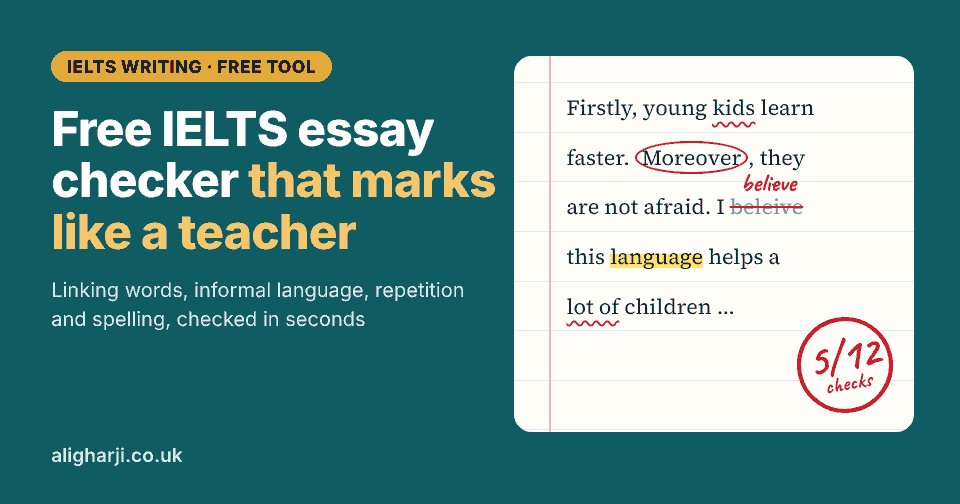
Paste a paragraph from your essay into the checker below. It highlights the words and phrases that AI tools overuse, suggests plainer alternatives and shows how varied your sentence lengths are. Click Try an example to see it in action.
Two things to keep in mind. This is not an AI detector, and it cannot prove who wrote anything. It is not a way to disguise AI-written work either: swapping a few words does not make someone else's ideas yours. It is simply a quick way to spot vocabulary habits. Your text never leaves your browser, so it is safe to paste coursework.
How to write in your own voice (and protect yourself)
Keep your drafting trail. Write in Word or Google Docs with version history on, save early drafts and keep your reading notes. If you are ever questioned, this is your strongest evidence.
Choose the plain word. "Show" is no less academic than "showcase". Markers reward clear, precise vocabulary, not decoration.
Vary your sentences. Mix short sentences with longer ones. A run of sentences that are all the same length reads as mechanical, whoever wrote it.
Be specific. Refer to your module readings, page numbers, your own data and examples from class. Generic statements could come from anywhere; specific ones come from you.
Know the rules and declare your tools. Check what your university and module allow. If you used Grammarly, a translator or an AI tool in a permitted way, say so.
Avoid AI humaniser tools. They rewrite your work in unpredictable ways, can introduce errors and may themselves break your university's rules.
Accused of using AI when you didn't? Six steps to take
Stay calm and read the rules. Read the allegation and your university's academic misconduct and AI policies before you reply.
Ask to see the evidence. Request everything the university is relying on, in writing, before any meeting or viva. In one OIA case, a complaint was upheld in full partly because none of the evidence had been shared with the student before their viva.
Gather your drafting trail. Version history, early drafts, notes, reading lists and the sources you used.
Be ready to talk about your work. Expect questions about your argument, your sources and how you wrote it. Be honest about any tools you used.
Get independent advice. Your Students' Union advice service is free and knows how the process works.
Appeal if the outcome is unfair. Use your university's appeal process first. After that, you can complain to the independent ombudsman: the OIA in England and Wales, the SPSO in Scotland or NIPSO in Northern Ireland. Keep copies of everything, as there may be time limits.
A detector score is a probability, not proof. A fair process looks at your work, your drafts and your understanding.
A note for lecturers
Treat a detector score as a reason to talk to a student, not as a verdict. Staged submissions, short conversations about the work and assessment that asks students to apply ideas to their own context tell you far more than a percentage, and they are fairer to students writing in their second language. I share more practical ideas in How Universities Can Strengthen Critical Thinking Across Disciplines.
Want feedback that builds your own voice?
The best protection against a false flag is writing that sounds unmistakably like you: clear, specific and well structured. In my Academic Writing course we work on your real assignments in one-to-one online sessions, with written feedback on your drafts, so you build a confident academic voice and a drafting trail along the way. Book your first session here.
Related reading: The Key Differences Between Academic Writing and Everyday Writing and Must-Try Free AI Tools for Academic Writing.
Sources
Liang, W. et al. (2023) GPT detectors are biased against non-native English writers. Patterns. Summary by Stanford HAI.
Kobak, D. et al. (2025) Delving into LLM-assisted writing in biomedical publications through excess vocabulary. Science Advances.
Turnitin (2023) AI writing detection update from Turnitin's chief product officer.
Office of the Independent Adjudicator (2025) AI and academic misconduct case summary CS072502.
Aformeziem, B. (2026) Catching the wrong students: AI detection, international students and the fairness crisis in UK universities. HEPI.
Times Higher Education (2026) Fear of being flagged by AI detectors drives stress among students.
Mount Royal University (2026) Advisory: AI writing detection.
The Guardian (2025) Revealed: thousands of UK university students caught cheating using AI.
Comments