5 IELTS Writing Task 2 Mistakes That Cost You Marks (and How to Fix Them)
Updated: 11 hours ago
Writing Task 2 is the part of IELTS that worries my students most, and for good reason. It carries twice the weight of Task 1 in your Writing score, and you have around 40 minutes to write at least 250 words on a topic you've never seen before.
After years of marking and teaching IELTS essays, I see the same mistakes again and again. Most of them have nothing to do with how good your English is. They come from misunderstanding what the examiner is actually looking for.
Examiners score your essay on four equally weighted criteria: Task Response, Coherence and Cohesion, Lexical Resource and Grammatical Range and Accuracy. Each mistake below costs marks in at least one of them.
1. Not answering every part of the question
Many Task 2 questions have two parts, and students often answer only one.
Question: Some people think children should start school at a very young age. Others think they should begin later. Discuss both views and give your own opinion.
This asks for three things: the first view, the second view, and your opinion. An essay that discusses both views brilliantly but never clearly states the writer's opinion can't score highly for Task Response, however good the language is.
The fix: before you write anything, underline every instruction in the question (discuss both views, give your opinion, what are the causes, suggest solutions). Then check your plan covers each one.
2. Hiding your position
In opinion essays, students often "sit on the fence" to seem balanced, or save their opinion for the final line.
Weak: There are many advantages and disadvantages to this issue, and people have different opinions.
Stronger: While early schooling can help some children socially, I believe most children benefit more from starting formal education at around six or seven.
The fix: state your position clearly in the introduction, keep it consistent throughout, and restate it in your conclusion. A clear position makes your whole essay easier to follow.
3. Relying on memorised phrases
Opening lines like "In this contemporary era, it is a highly debatable issue whether..." feel safe, but examiners recognise memorised language instantly and don't give credit for it. It also often doesn't quite fit the question, which makes your writing sound unnatural.
The fix: paraphrase the question in your own words instead. It's shorter, more natural, and shows the examiner real vocabulary range. For the question above, you could simply write: Opinions differ on the best age for children to begin formal education.
4. Overusing linking words
Students are often taught that linking words improve Coherence and Cohesion, so they start every sentence with Moreover, Furthermore or In addition. Overused, this has the opposite effect: the writing feels mechanical, and connectors are sometimes used incorrectly.
The fix: use linking words only where they show a real relationship between ideas (contrast, cause, example), and vary how you connect sentences. Pronouns such as this, these or such an approach, along with good paragraphing, often create cohesion more naturally than connectors do.
5. Making claims without developing them
This is the most common reason essays get stuck at Band 6. Students list several ideas but explain none of them.
Underdeveloped: Starting school early is good because children learn social skills. It also helps parents. It prepares children for the future.
Developed: Starting school early can help children develop social skills. In a classroom, they learn to share, take turns and resolve disagreements with others their age, experiences that are difficult to replicate at home.
The fix: in each body paragraph, choose one main idea and develop it fully: explain it, then support it with an example or consequence. Two well-developed ideas beat four undeveloped ones.
A quick checklist before you finish
Have I answered every part of the question?
Is my position clear from the introduction?
Have I written at least 250 words?
Is each main idea explained and supported?
Have I left 3 to 5 minutes to check for errors?
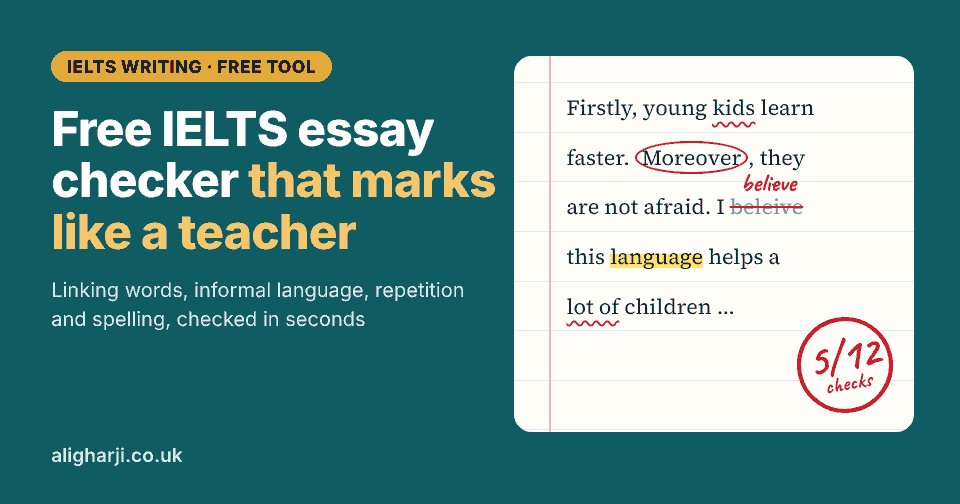
Check your own essay for these mistakes. Paste it into The Red Pen, a free IELTS essay checker. It marks memorised phrases, overused linking words, informal style, repetition and spelling in seconds, and links each problem to the official band descriptors.
Want feedback on your own essays?
Knowing these mistakes is one thing. Spotting them in your own writing is much harder. In my IELTS Preparation course, you get full practice tests, detailed written feedback on your essays and a personalised study plan, delivered one-to-one online. Book your first session here.
Comments